


Humidity in Pharmaceutical Manufacturing: From Drug Product Requirements to HVAC Design

Humidity in Pharmaceutical Manufacturing: From Drug Product Requirements to HVAC Design

A powder that no longer flows as well. Granules that no longer compress in the same way. A capsule shell that becomes more brittle.
In the pharmaceutical industry, environmental conditions can influence the behaviour of moisture-sensitive products. A relative humidity value therefore represents far more than a question of room comfort: it can directly affect process control and the reproducibility of the manufactured product.
Air treatment is therefore not an end in itself. Filtration, pressure cascades, microbiological control, air changes, temperature and humidity all serve the same purpose: helping ensure that a medicinal product retains its identity, quality, safety and efficacy through to administration. This principle lies at the heart of Good Manufacturing Practice (GMP).
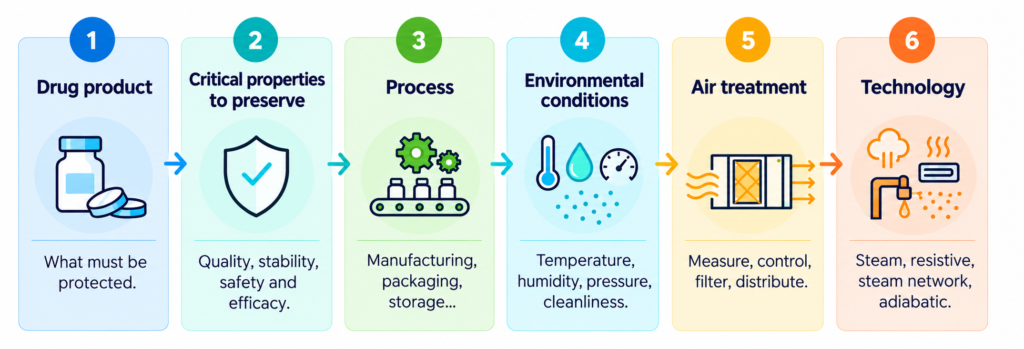
The starting point is never the room, the air handling unit (AHU) or the humidifier. The starting point is the drug product, the process and the associated product risk.
Within this broader set of environmental requirements, humidity plays a particular role. Some operations are relatively insensitive to it, whereas others can be directly affected by moisture exchange between the ambient air and exposed materials.
For many active pharmaceutical ingredients (APIs), excipients, powders, granules and intermediate products, air humidity is more than a building operating parameter. It can alter the product’s moisture content and, consequently, some of its physical and formulation properties: flowability, powder flow behaviour, response to static electricity, tendency to agglomerate, and the mechanical properties of granules intended for compression.
The question is therefore not simply:
“What relative humidity should be maintained in this room?”
but rather:
“What environmental conditions are required to preserve the properties of the drug product and maintain process control throughout the manufacturing process?”
Once this pharmaceutical requirement has been identified, it must be translated into measurable environmental parameters, and then into engineering solutions capable of maintaining them consistently over time.
This is precisely where Devatec’s expertise lies: at the interface between pharmaceutical requirements and air treatment engineering.
How does humidity affect pharmaceutical products?
Dans une zone de fabrication pharmaceutique, lorsqu’une poudre, un granulé, un mélange, un produit intermédiaire ou un médicament fini est exposé à l’air ambiant, des échanges d’eau peuvent se produire entre le produit et son environnement.
In a pharmaceutical manufacturing area, when a powder, granule, blend, intermediate product or finished medicinal product is exposed to ambient air, moisture exchange can occur between the product and its environment.
Relative humidity, moisture content and water activity: what are the differences?
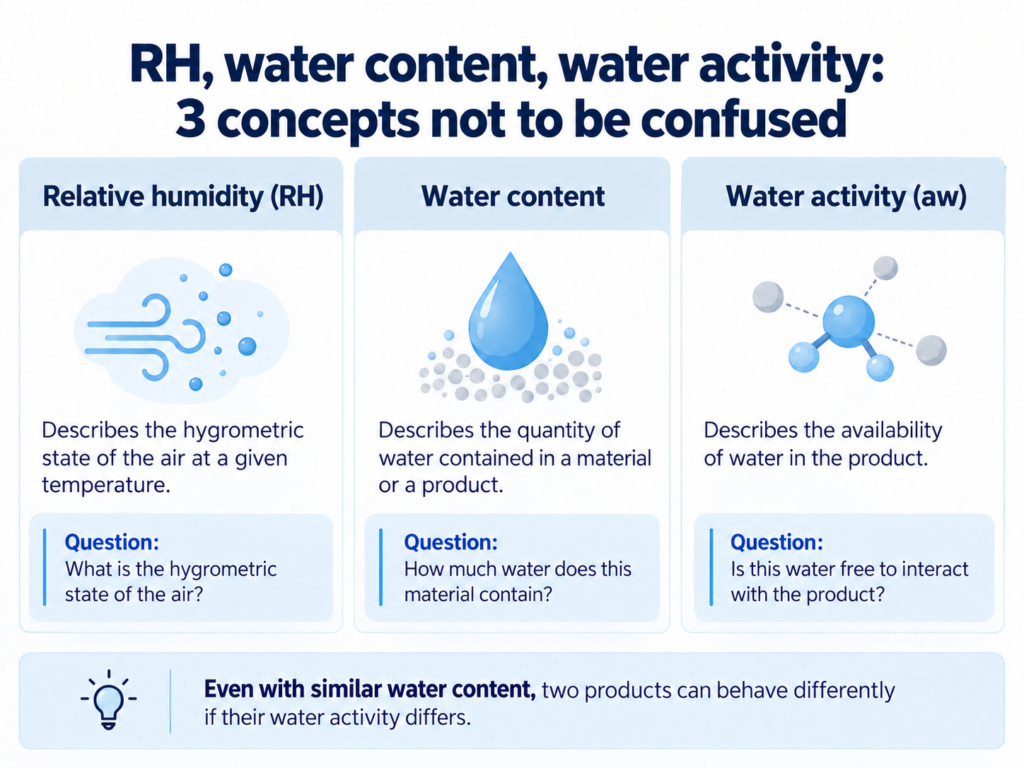
In pharmaceutical formulation, three concepts must be distinguished:
- relative humidity (RH) describes the humidity condition of the air;
- moisture content describes the amount of water contained in the product;
- water activity (aw) reflects the availability of this water within the product.
How does a pharmaceutical product exchange moisture with ambient air?
The air and the product gradually move towards hygroscopic equilibrium. When the ambient air is drier than the product’s equilibrium condition, the product tends to lose moisture. When the air is more humid, the product tends instead to adsorb moisture.
The rate and extent of these exchanges depend in particular on the nature of the product, its specific surface area, exposure time, temperature, and hygroscopic sensitivity.
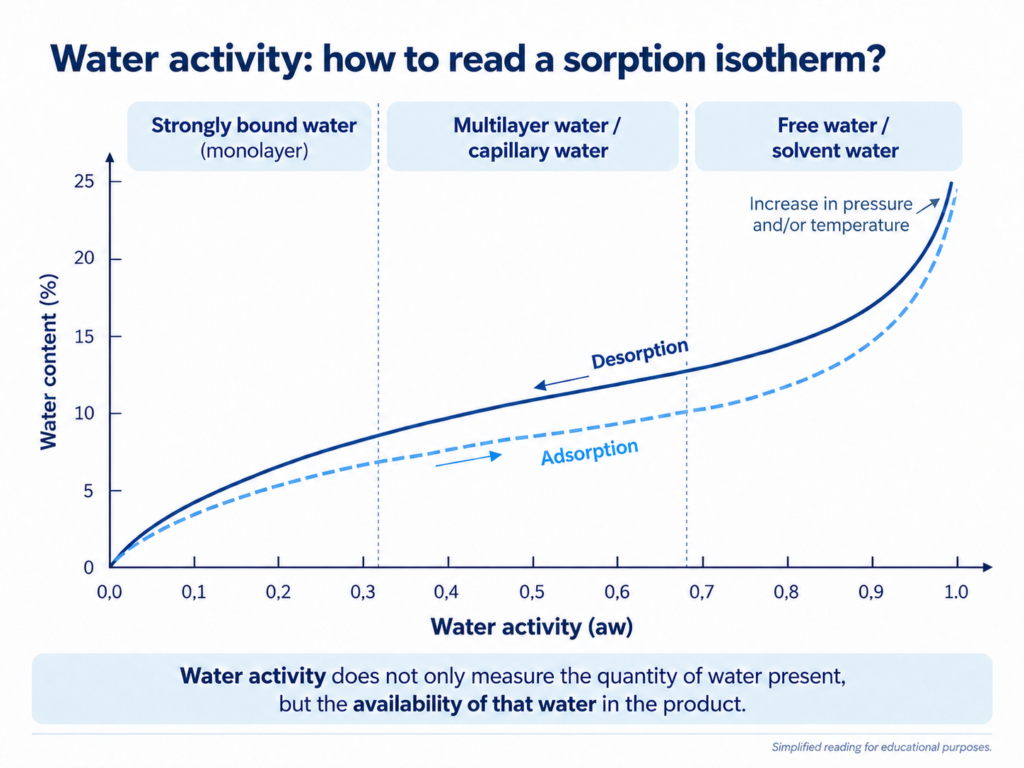
What is the relationship between water activity and equilibrium relative humidity?
At thermodynamic equilibrium and at a given temperature, the water activity of a product is directly related to the relative humidity of the surrounding air:
ERH (%) ≈ aw × 100
where ERH = Equilibrium Relative Humidity and aw = water activity.
| Product water activity | Equilibrium relative humidity of the surrounding air |
|---|---|
| aw = 0,30 | ≈ 30 % HR |
| aw = 0,50 | ≈ 50 % RH |
| aw = 0,75 | ≈ 75 % RH |
Why can two powders with the same moisture content behave differently?
Two products can have an identical moisture content but a different water activity.
For the formulation scientist, water activity can therefore be more relevant than total moisture content alone, as it reflects the water actually available for chemical reactions, degradation mechanisms, microbial growth, and certain processing behaviours.
What effects can humidity have on powders, granules and tablets?
The formulation properties of many pharmaceutical powders are directly influenced by their moisture level.
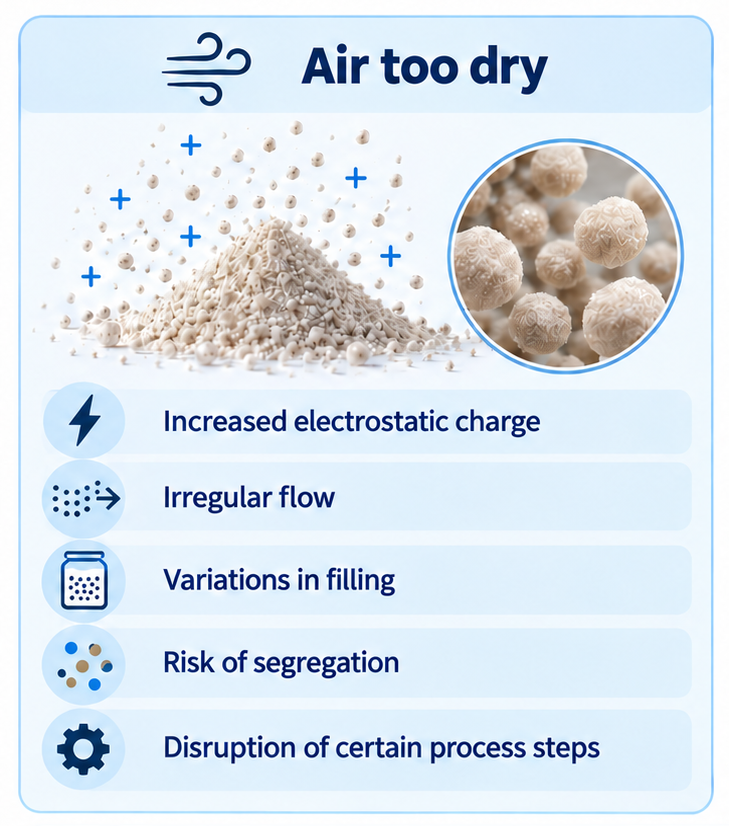
| increase in static electricity |
| changes in flowability |
| variations in die filling |
| changes in compressibility |
| changes in tablet hardness |
| increased friability |
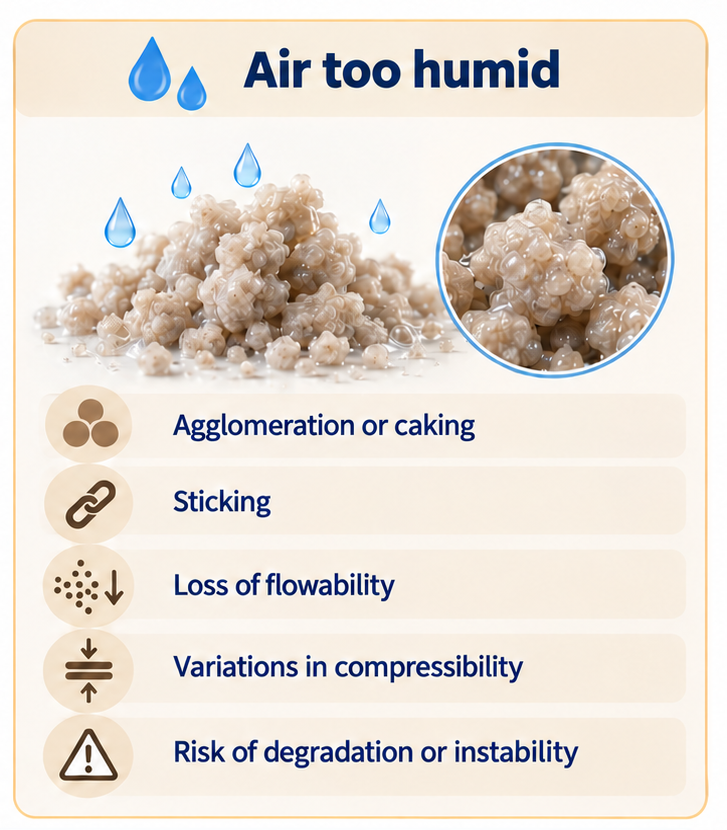
| agglomeration and caking |
| loss of flowability |
| sticking to equipment |
| increased friability |
Dry air and static electricity: what is the link in pharmaceutical manufacturing?
When relative humidity drops significantly, the natural dissipation of electrostatic charges becomes less effective.
In operations involving powders or granules, this can promote particle adhesion to surfaces, disrupt powder flow or equipment feeding, complicate certain packaging operations, and increase dust attraction.
Maintaining humidity levels suited to the process therefore helps limit the accumulation of electrostatic charges.
What is the relationship between water activity and microbial growth?
Microbial growth depends more on **water activity** than on the product’s total moisture content alone.
Water must be available to support bacterial growth, yeast development, or mould proliferation.
Which products and manufacturing stages are particularly sensitive to humidity?
The extent of **moisture exchange with the environment** varies depending on the nature of the product and the stage of the manufacturing process.
Raw materials and excipients: Some hygroscopic materials can rapidly gain or lose moisture after their packaging has been opened.
Granules intended for compression: Changes in their moisture content can affect flowability, compressibility, and final tablet hardness.
Capsules: Excessively dry air can cause gelatin capsule shells to lose moisture, increasing the risk of brittleness or cracking.
Powders exposed during transfer or weighing: Static electricity is more likely to build up in very dry environments.
Understanding the relationship between relative humidity, water activity, moisture content and formulation properties is therefore an essential step before even considering the air handling unit (AHU) or humidification system.
The question then becomes:
“What RH range, control tolerance and moisture condition are required to preserve product properties and maintain process control?”
Only after this pharmaceutical requirement has been defined should HVAC and humidification design begin.
What relative humidity should be maintained in pharmaceutical manufacturing?
There is no universal relative-humidity setpoint for pharmaceutical manufacturing areas.
Setpoints and acceptable operating ranges should be established from product and process requirements, scientific knowledge and quality risk assessment, with operator comfort and contamination-control needs considered where relevant.
Two areas with the same cleanliness classification may therefore require different temperature and humidity conditions.
Do GMP requirements impose a specific humidity level?
Good Manufacturing Practice (GMP) defines requirements relating in particular to contamination control, airflow, filtration, ventilation, pressure cascades and environmental control. However, GMP does not prescribe a single temperature or humidity level applicable to all areas: these parameters must be justified based on the product, the process and the associated risks.
A blending room, compression room, weighing room, packaging area, or raw-material or finished-product storage area may therefore handle products with very different hygroscopic sensitivities.
Examples of environmental conditions encountered in pharmaceutical manufacturing*
| Manufacturing area | Dry-bulb temperature | Relative humidity | Main objective |
| Raw-material receiving and storage | 18 – 22°C (64 – 72°F) | 30 to 55 % | Maintain suitable storage conditions and limit moisture uptake/loss for sensitive raw materials |
| Powder blending | 20 – 22°C (68 – 72°F) | 30 to 45 % | Support consistent handling and blend behaviour; limit agglomeration or segregation where moisture-sensitive |
| Granulation | 20 – 22°C (68 – 72°F) | 30 to 45 % | Control granule moisture condition before downstream processing |
| Tablet compression | 20 – 22°C (68 – 72°F) | 30 to 45 % | Support consistent flow, die filling, compaction and tablet mechanical properties |
| Primary packaging | 20 – 25°C (68 – 77°F) | 40 to 50 % | Limit electrostatic effects and support packaging consistency |
How can a pharmaceutical requirement be translated into an HVAC design requirement?
At this stage, the question is no longer whether humidity affects the product or the process. It becomes: how can the environmental conditions required for process control be maintained consistently over time?
This is precisely where Devatec’s approach comes into play: at the interface between pharmaceutical process requirements and air treatment engineering.
What data is required to size humidification for a pharmaceutical area?
Two installations targeting the same relative humidity may require very different technical solutions.
Key design inputs include:
- design airflow rate through the AHU;
- outdoor-air fraction;
- local winter and summer design conditions;
- target RH and allowable control tolerance;
- available water quality and treatment;
- available utilities, energy strategy and operating requirements.
Humidifier selection should therefore never be based on a target RH value alone.
To translate these requirements into air-treatment needs, the engineering study may also consider outdoor-air conditions, its humidity ratio, the humidification load to be met, the required modulation capacity, as well as the conditions for steam or moisture dispersion, absorption and control within the AHU.
Steam or adiabatic humidification: which technology fits pharmaceutical HVAC applications?
Which technology should be considered according to the utilities and AHU design?
Technology selection depends on the utilities available, the psychrometric duty and the architecture of the air-handling system:
- where electrical power is available: electric steam humidification using ELMC electrode steam humidifiers or RTH resistive steam humidifiers;
- where pressurised steam is available: live/pressurised steam can be conditioned and distributed into the airstream;
- where the air state, AHU space, water quality, hygiene design and thermal balance are suitable: evaporative adiabatic humidification can be considered and may reduce the direct energy input otherwise required for steam generation.
When should steam humidification be considered?
Where the application calls for direct addition of steam to the airstream, Devatec offers electric steam and pressurised/live-steam solutions.
ELMC electrode steam humidifiers use the natural conductivity of water to generate steam. This technology is particularly well suited to industrial applications requiring robust operation, straightforward installation and a wide modulation range.
RTH resistive steam humidifiers generate steam independently of water conductivity. They can therefore operate with certain types of treated water and are well suited to applications requiring precise control of steam production.
If pressurised steam is already available on site, it can be routed to the AHU and reduced to atmospheric pressure before being injected into the air stream using steam-conditioning solutions such as the Series 9000 and 1000.
In all cases, the objective is stable humidity control without wetting downstream components, with appropriate steam distribution, absorption distance, condensate management and control safeguards.
When can evaporative adiabatic humidification be considered?
Not every pharmaceutical HVAC application requires steam generation.
In suitable air handling units, evaporative adiabatic humidification can provide an alternative to steam humidification. Water evaporates from wetted media into the airstream. The latent heat required for evaporation is taken from the sensible heat of the air, so the air is humidified and cooled, approximately along a constant-enthalpy process.
EvaPack® is an evaporative-media humidifier/cooler designed for this purpose. Its cooling effect can contribute to the overall energy strategy when the thermal balance of the AHU makes that cooling useful.
HCE: how does it address hygienic requirements for humidification?
For applications requiring rigorous control of hygiene and water quality, Devatec has developed the HCE concept – Hygienic and Controlled Evaporation.
This approach combines, among other features:
- the use of reverse osmosis (RO) water;
- the continuous monitoring of the evaporation process;
- the controlled management of the different operating phases;
- the possible integration of preheating strategies adapted to climatic conditions;
- a design focused on the cleanliness and maintenance requirements of pharmaceutical installations.
When does humidification also become an energy issue?
In some projects, the choice of humidification method is not driven solely by a humidity requirement. It can also influence the overall energy performance of the air-treatment system.
An adiabatic solution such as EvaPack® uses the sensible heat of the air to evaporate water while simultaneously providing a cooling effect. Depending on the AHU operating conditions, this effect can be taken into account in the overall energy analysis of the system.
However, the potential benefit must be assessed at the whole-system level and under the actual operating conditions of the project.
HumiData: supporting objective design decisions
HumiData is a selection-support tool developed by Devatec’s engineering department. Using project data and real climatic data, it compares several humidification scenarios (electric steam humidification, live steam and adiabatic evaporation) and generates a concise comparison report.

The report can compare the sized system requirements and, depending on the scenarios assessed, energy and water consumption, energy costs, and CO₂ emissions. The objective is to support an objective technology selection based on the project’s technical, energy and operational constraints.
FAQ: Humidity and Humidification in Pharmaceutical Manufacturing
What humidity level should be maintained in pharmaceutical manufacturing?
There is no single humidity level applicable across the entire pharmaceutical industry. The setpoint must be defined according to the product, the process, the manufacturing stage and the associated risks. The objective is to maintain environmental conditions that are compatible with the properties of the medicinal product and the reproducibility of the process, rather than applying the same RH value to every area.
Do GMP requirements specify a precise humidity level?
GMP requirements govern the control of the manufacturing environment, but they do not prescribe a universal temperature or relative humidity level applicable to all pharmaceutical rooms. These parameters must be justified according to the product, the process and the risk assessment. Two areas with the same classification may therefore have different humidity requirements.
What is the difference between relative humidity, moisture content and water activity?
Relative humidity (RH) describes the moisture condition of the air. Moisture content refers to the amount of water contained in the product. Water activity (aw) reflects the availability of that water within the product. These three concepts are related, but they do not describe the same phenomenon. At equilibrium and at a given temperature, water activity is related to equilibrium relative humidity according to the relationship ERH (%) ≈ aw × 100.
Why are powders, granules and tablets sensitive to humidity?
The moisture level can influence several formulation properties, including flowability, electrostatic behaviour, die filling, compressibility, tablet hardness and friability. Conversely, excessive moisture uptake can promote agglomeration, caking, loss of flowability or sticking to equipment. The objective is therefore not to keep the product as dry as possible, but to maintain humidity conditions compatible with its formulation and processing characteristics.
What is the relationship between dry air and static electricity in pharmaceutical manufacturing?
When relative humidity drops significantly, the natural dissipation of electrostatic charges becomes less effective. With powders or granules, this can promote particle adhesion to surfaces, flow difficulties, inconsistent equipment feeding, or increased dust attraction. Maintaining humidity conditions suited to the process helps limit the accumulation of electrostatic charges.
Why can two pharmaceutical rooms require different humidity conditions?
Because the humidity setpoint does not depend solely on the room classification. It also depends on the materials being handled, their hygroscopic sensitivity, the manufacturing stage, and the process requirements. A weighing room, blending area, compression room, or packaging area may therefore require different humidity conditions, even within the same pharmaceutical facility.
Steam or adiabatic humidification: how should the choice be made in pharmaceutical applications?
The choice depends on the requirements of both the process and the installation. Isothermal solutions can generate steam electrically or use pressurised steam already available on site, conditioned before injection into the air stream. An adiabatic solution such as EvaPack® evaporates water by using the sensible heat of the air, while simultaneously providing a cooling effect. The selection should therefore take into account the required environmental conditions, the AHU configuration, available energy sources, water quality, operating requirements, and the project’s energy-performance objectives.
References and Sources
Note to the reader: The temperature and humidity values mentioned in this article are provided as examples drawn from real pharmaceutical projects and technical literature. They do not constitute universal GMP requirements. Environmental conditions must always be justified based on the product characteristics, process requirements, and the risk assessment performed by the pharmaceutical site.
Regulatory References
Commission Européenne. EudraLex Volume 4 – EU Guidelines for Good Manufacturing Practice for Medicinal Products for Human and Veterinary Use – Part I, Chapter 3: Premises and Equipment.
Commission Européenne. EudraLex Volume 4 – Annex 1: Manufacture of Sterile Medicinal Products. Révision 2022.
U.S. Food and Drug Administration (FDA). Code of Federal Regulations – Title 21 Part 211: Current Good Manufacturing Practice for Finished Pharmaceuticals.
World Health Organization (WHO). Guidelines on Heating, Ventilation and Air-Conditioning Systems for Non-Sterile Pharmaceutical Products. WHO Technical Report Series.
Haycocks N., Goldschmidt N., Thomsen U. Temperature & Humidity Requirements in Pharmaceutical Facilities. Pharmaceutical Engineering, septembre/octobre 2021, ISPE.
Scientific and Pharmaceutical Formulation References
Airaksinen S. Role of Excipients in Moisture Sorption and Physical Stability of Solid Pharmaceutical Formulations. University of Helsinki.
Waterman K.C., Adami R.C., et al. Application of Water Activity Determination to Nonsterile Pharmaceutical Products.
Lachman L., Lin S. Electrostatic Characteristics of Pharmaceutical Solids and Packaging Materials I. Journal of Pharmaceutical Sciences. 1968;57(3):504-510.
Koumbogle K., Gosselin R., Gitzhofer F., Abatzoglou N. Moisture Behavior of Pharmaceutical Powder during the Tableting Process. Pharmaceutics. 2023;15(6):1652.
Brubaker J., Moghtadernejad S. A Comprehensive Review of the Rheological Properties of Powders in Pharmaceuticals. Powders. 2024;3(2):233-254.
Devatec / Armstrong Technical References
Devatec. ELMC Technical Documentation. Electrode Steam Humidifiers.
Devatec. RTH-LC and RTH-HC Technical Documentation. Resistive Steam Humidifiers.
Devatec. EvaPack Technical Documentation. Adiabatic Humidification and Evaporation Control.
Devatec. HCE Concept – Hygienic and Controlled Evaporation
Devatec. HumiData. Humidification Technology Selection Tool and Comparative Analysis Report.
EvaPack® Technical Documentation: VDI 6022 certification, Euroclass A1, water quality requirements and proportional control.
Armstrong-Devatec case studies and field experience relating to pharmaceutical, biotechnology and cleanroom applications.


How should humidification for a pharmaceutical AHU be sized?
Sizing should not be based solely on a target humidity level. It must also take into account the treated airflow rate, outdoor-air fraction, local climatic conditions, required control accuracy, available water quality, and the site’s energy and operating constraints. The air-treatment study then translates these parameters into the appropriate **humidification capacity, modulation range, dispersion and control strategy** for the installation.